
Heading in Football

- 90% of diagnosed concussions occur without loss of consciousness.
- Recent studies show that heading the ball, even just 20 times in practice, causes immediate and measurable alterations to brain functioning.
- It has been documented that up to 22% of all soccer injuries are concussions. This is in part due to players purposely using their head to direct the ball during play.
- The current guidelines (England Football) don’t stop children from heading the ball in matches, but they do forbid heading the ball as part of training until the age of 12 – when it is gradually introduced.
- In addition, it was noted that water absorption by soccer balls can result in masses that substantially increase impact force.
Concussion symptoms range from mild to severe and include:
- loss of consciousness
- headache, which may range in intensity from mild to severe.
- poor memory or concentration
- sensitivity to noise, light, or both
- dizziness or vertigo
- blurred vision
- sudden mood changes, including irritability, unexplained crying, or depression.
- nausea or vomiting
- poor balance
- drowsiness
- fatigue
- reduced hearing
- trouble sleeping
FA to trial banning deliberate heading by children under 12 in England.
The FA is to trial the removal of heading in selected grassroots competitions and leagues, the FA will apply to Ifab (International Football Association Board ) for a” law change to remove heading at under-12 level and below from the 2023-24 season.”
It follows the introduction of guidance in 2020 which advised coaches against practising heading in training in football for children aged 11 and under, with a graduated introduction of light heading into training from under-12s up to under-16s level. A recommended limit of 10 high-force headers per week in training was also introduced into professional football and the adult grassroots game before the start of last season.
Alternatives to heading the ball.
- Step back chest down
- Step back use inner thigh to drop ball down.
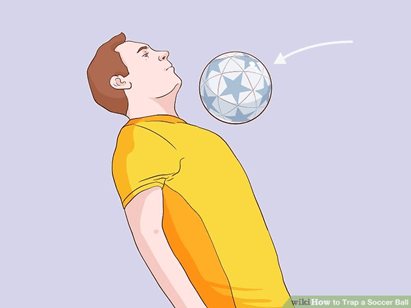
Practice leaning back slightly for a chest trap. A chest trap will stop a ball coming toward your torso and drop it down toward your feet. Stay on your toes so you can move around, and keep your knees slightly bent as the ball comes toward you. Lean back slightly as the ball hits your chest, letting it bounce forward and land near your feet
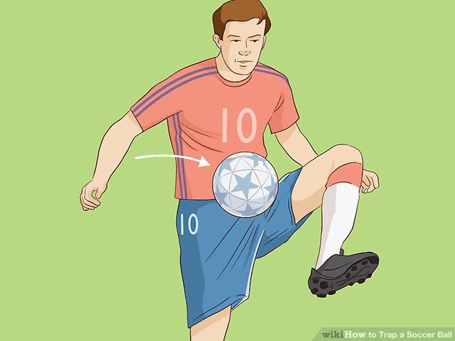
Lift your dominant leg to catch the ball for a thigh trap. A thigh trap involves bouncing the ball off the middle of your upper leg to gain control of it quickly. As the ball comes toward you, lift one of your legs so your thigh is slightly diagonal. Let the ball hit the middle of your thigh and begin straightening your legs as it falls toward your feet.
- Make sure the ball hits in the softer part of your thigh near the middle. If it hits your knee, it will bounce off at an unpredictable angle, and if it hits too high up on your leg you might catch it in your gut instead.
 Active Athletics